A Servlet, in its most general form, is an instance of a class which implements the javax.servlet.Servlet interface. Most Servlets, however, extend one of the standard implementations of that interface, namely javax.servlet.GenericServlet and javax.servlet.http.HttpServlet. In this tutorial we’ll be discussing only HTTP Servlets which extend the javax.servlet.http.HttpServlet class.
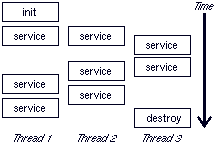
In order to initialize a Servlet, a server application loads the Servlet class (and probably other classes which are referenced by the Servlet) and creates an instance by calling the no-args constructor. Then it calls the Servlet’s init(ServletConfig config) method. The Servlet should performe one-time setup procedures in this method and store the ServletConfig object so that it can be retrieved later by calling the Servlet’s getServletConfig() method. This is handled by GenericServlet. Servlets which extend GenericServlet (or its subclass HttpServlet) should call super.init(config) at the beginning of the init method to make use of this feature. The ServletConfig object contains Servlet parameters and a reference to the Servlet’s ServletContext. The init method is guaranteed to be called only once during the Servlet’s lifecycle. It does not need to be thread-safe because the service method will not be called until the call to init returns.
When the Servlet is initialized, its service(ServletRequest req, ServletResponse res) method is called for every request to the Servlet. The method is called concurrently (i.e. multiple threads may call this method at the same time) so it should be implemented in a thread-safe manner.
When the Servlet needs to be unloaded (e.g. because a new version should be loaded or the server is shutting down) the destroy() method is called. There may still be threads that execute the service method when destroy is called, so destroy has to be thread-safe. All resources which were allocated in init should be released in destroy. This method is guaranteed to be called only once during the Servlet’s lifecycle.
 iDeveloper